From tropical disturbances to cyclones
Work in progressWhere do tropical cyclone precursors form, which environments favor their development, and how predictable are these steps?
Most tropical disturbances never become cyclones. Understanding cyclone formation therefore requires separating the supply of precursor disturbances, or seeds, from the conditions that allow them to develop. These two stages need not respond in the same way to the surrounding circulation.
At Berkeley, I use ERA5 reanalysis and tracked vortices to examine how regional jets, vorticity, shear, and moisture relate to seed formation and subsequent development across basins and seasons. By distinguishing these stages, I aim to understand the formation mechanisms of tropical cyclone seeds and how their environment shapes their development and predictability.
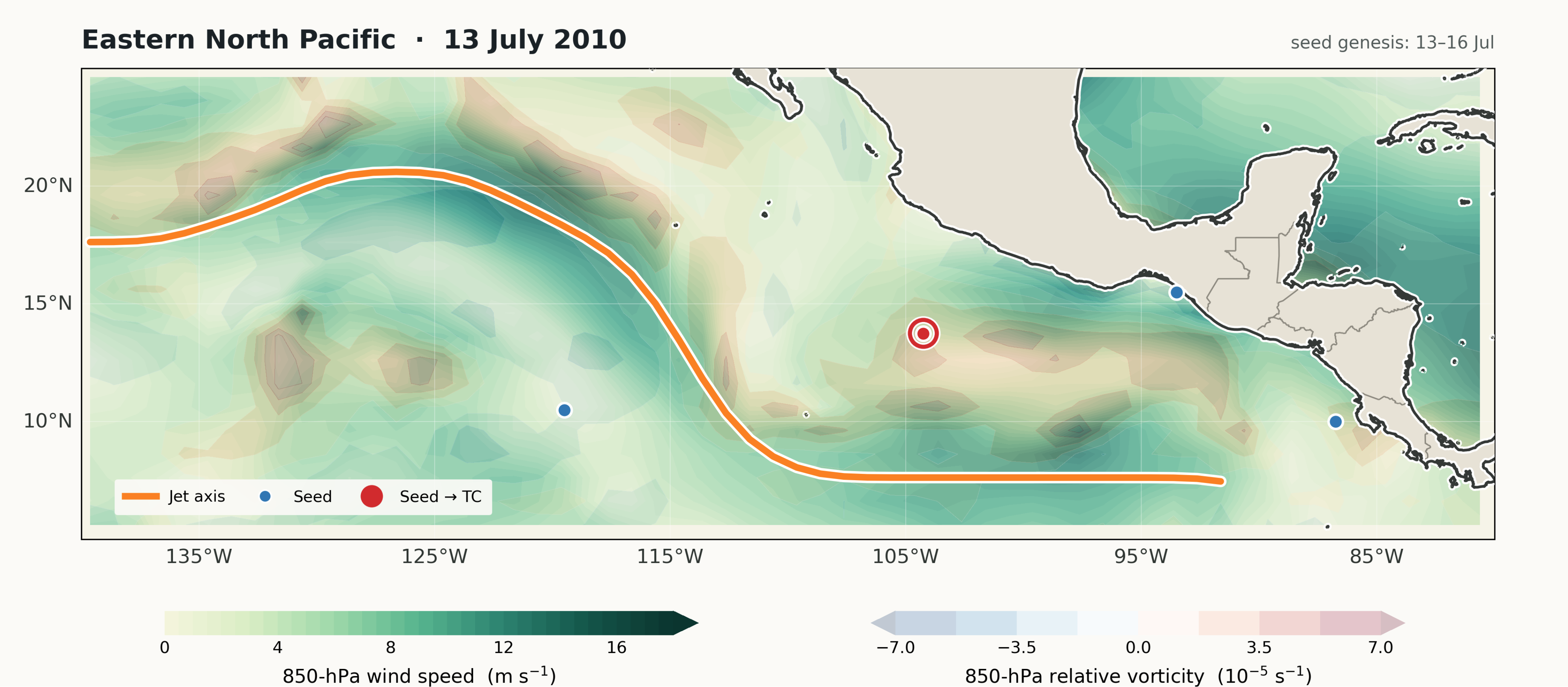
Conceptual illustration of tropical cyclone seeds and their environment in the eastern North Pacific. The orange line marks the jet axis; blue points mark seeds, and red marks a seed that develops into a tropical cyclone.
Ongoing research with William R. Boos.
Jupiter’s polar cyclones
What maintains Jupiter’s polar cyclone patterns, and what can their motion tell us about their depth?
Juno’s first close views of Jupiter’s poles revealed an unexpected arrangement: a central cyclone surrounded by eight cyclones in the north and five in the south. Why do these giant storms remain in organized patterns rather than merge or drift into the pole? What sets their number and spacing? What drives their motion, and how far do they extend beneath the clouds? These questions motivated my PhD research.
Combining Juno observations with idealized vortex models, I developed a dynamical picture in which interactions among the cyclones and with the background vorticity account for both their stable arrangement and their motion. The balance that maintains the patterns also allows oscillations, while a center-of-mass framework explains their collective westward drift. That drift provides a further constraint on the cyclones’ vertical structure, connecting what Juno sees at the cloud level to the atmosphere below.
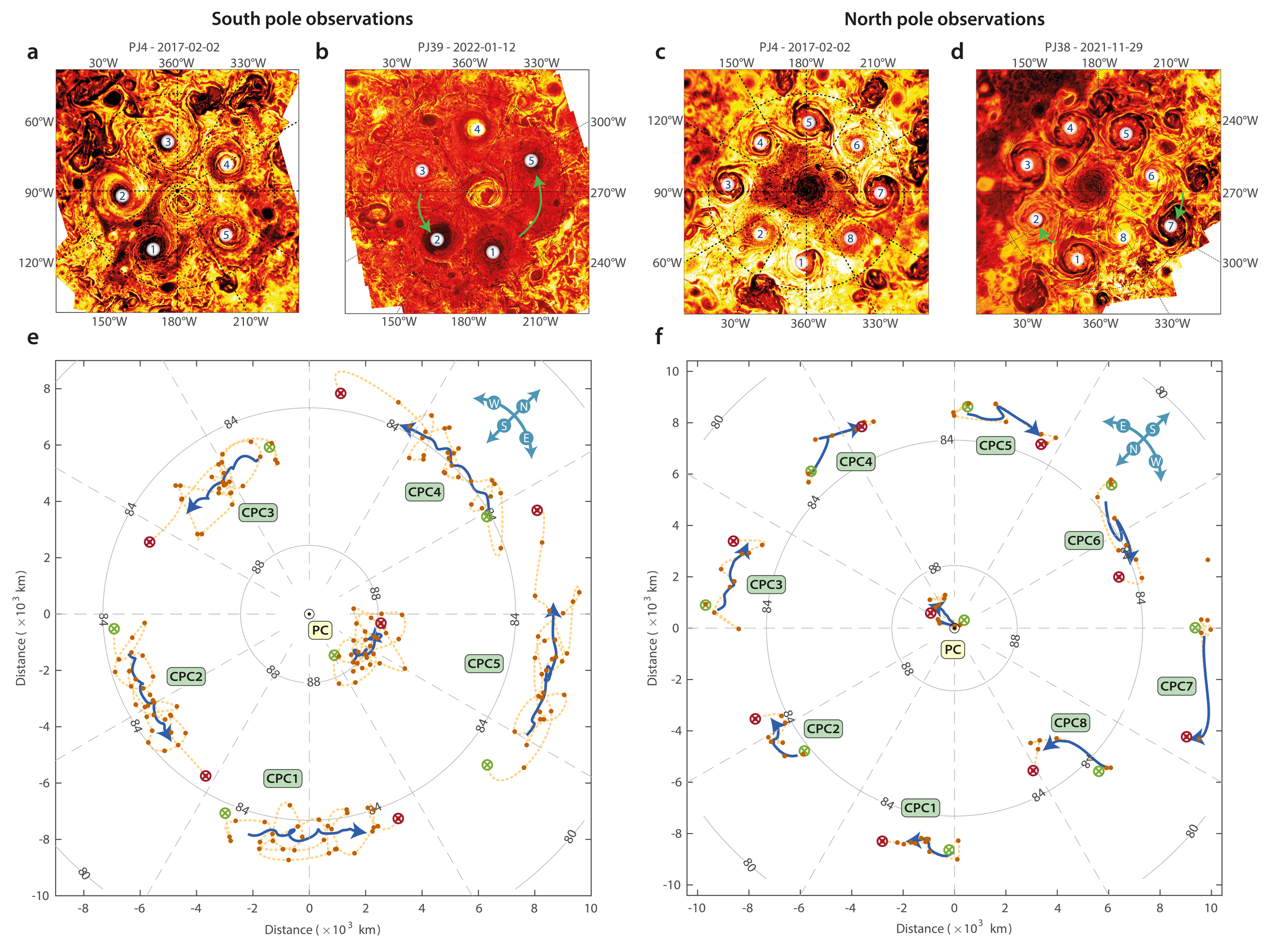
Juno observations show persistent polar patterns whose cyclones oscillate and drift westward over several years.
Gavriel & Kaspi (2023), Fig. 1
JIRAM image panels adapted from Mura et al. (2022), as credited in the paper.
Related publications
-
Dynamical constraints on the vertical structure of Jupiter’s polar cyclones
2025 · Proceedings of the National Academy of Sciences, 122 (44), e2503737122
Published version ↗arXiv preprint ↗BibTeX
@article{gavriel2025depth, author = {Gavriel, Nimrod and Kaspi, Yohai}, journal = {Proceedings of the National Academy of Sciences}, doi = {10.1073/pnas.2503737122}, number = {44}, year = {2025}, pages = {e2503737122}, title = {Dynamical constraints on the vertical structure of {Jupiter}\textquoteright{}s polar cyclones}, url = {https://arxiv.org/abs/2502.12789}, howpublished = {https://arxiv.org/abs/2502.12789}, volume = {122}, } -
The Westward Drift of Jupiter's Polar Cyclones Explained by a Center‐of‐Mass Approach
2023 · Geophysical Research Letters, 50 (19), e2023GL103635
Published version ↗arXiv preprint ↗BibTeX
@article{gavriel2023drift, author = {Gavriel, Nimrod and Kaspi, Yohai}, journal = {Geophysical Research Letters}, doi = {10.1029/2023GL103635}, number = {19}, year = {2023}, pages = {e2023GL103635}, title = {The {Westward} {Drift} of {Jupiter}'s {Polar} {Cyclones} {Explained} by a {CenterofMass} {Approach}}, url = {https://arxiv.org/abs/2311.11917}, howpublished = {https://arxiv.org/abs/2311.11917}, volume = {50}, } -
The Oscillatory Motion of Jupiter's Polar Cyclones Results From Vorticity Dynamics
2022 · Geophysical Research Letters, 49 (15), e2022GL098708
Published version ↗arXiv preprint ↗BibTeX
@article{gavriel2022oscillations, author = {Gavriel, Nimrod and Kaspi, Yohai}, journal = {Geophysical Research Letters}, doi = {10.1029/2022GL098708}, number = {15}, year = {2022}, pages = {e2022GL098708}, title = {The {Oscillatory} {Motion} of {Jupiter}'s {Polar} {Cyclones} {Results} {From} {Vorticity} {Dynamics}}, url = {https://arxiv.org/abs/2209.00309}, howpublished = {https://arxiv.org/abs/2209.00309}, volume = {49}, } -
The number and location of Jupiter’s circumpolar cyclones explained by vorticity dynamics
2021 · Nature Geoscience, 14 (8), 559-563
Nature Geoscience cover · August 2021 ↗
Published version ↗arXiv preprint ↗BibTeX
@article{gavriel2021cyclones,
	author = {Gavriel, Nimrod and Kaspi, Yohai},
	journal = {Nature Geoscience},
	doi = {10.1038/s41561-021-00781-6},
	number = {8},
	year = {2021},
	pages = {559--563},
	title = {The number and location of {Jupiter}\textquoteright{}s circumpolar cyclones explained by vorticity dynamics},
	url = {https://arxiv.org/abs/2110.09422},
	howpublished = {https://arxiv.org/abs/2110.09422},
	volume = {14},
}
Planetary circulation, convection, and jets
What lies beneath Jupiter’s cloud bands, and how do convection columns contribute to its deep flows and jets?
Jupiter’s cloud bands express powerful jets, but also conceal deeper circulation cells. These cells are theorized to connect the jets to the hot interior, distributing heat and momentum across the planet. Constraining their structure and understanding how they work is a key challenge in understanding the climate of Jupiter and the other giant planets.
We use cloud-penetrating microwave measurements from the Juno spacecraft to reveal fine-scale spatial patterns and compare them with theoretical predictions of these cells. In our manuscript in review, two distinct observational signatures, supported by three-dimensional convection modeling, provide evidence for tilted convective columns and constrain their geometry and wavelength.
Alongside these observations, I am developing a reduced model of rotating convection to isolate how the columns transport momentum and under what conditions they can sustain an eastward equatorial jet.
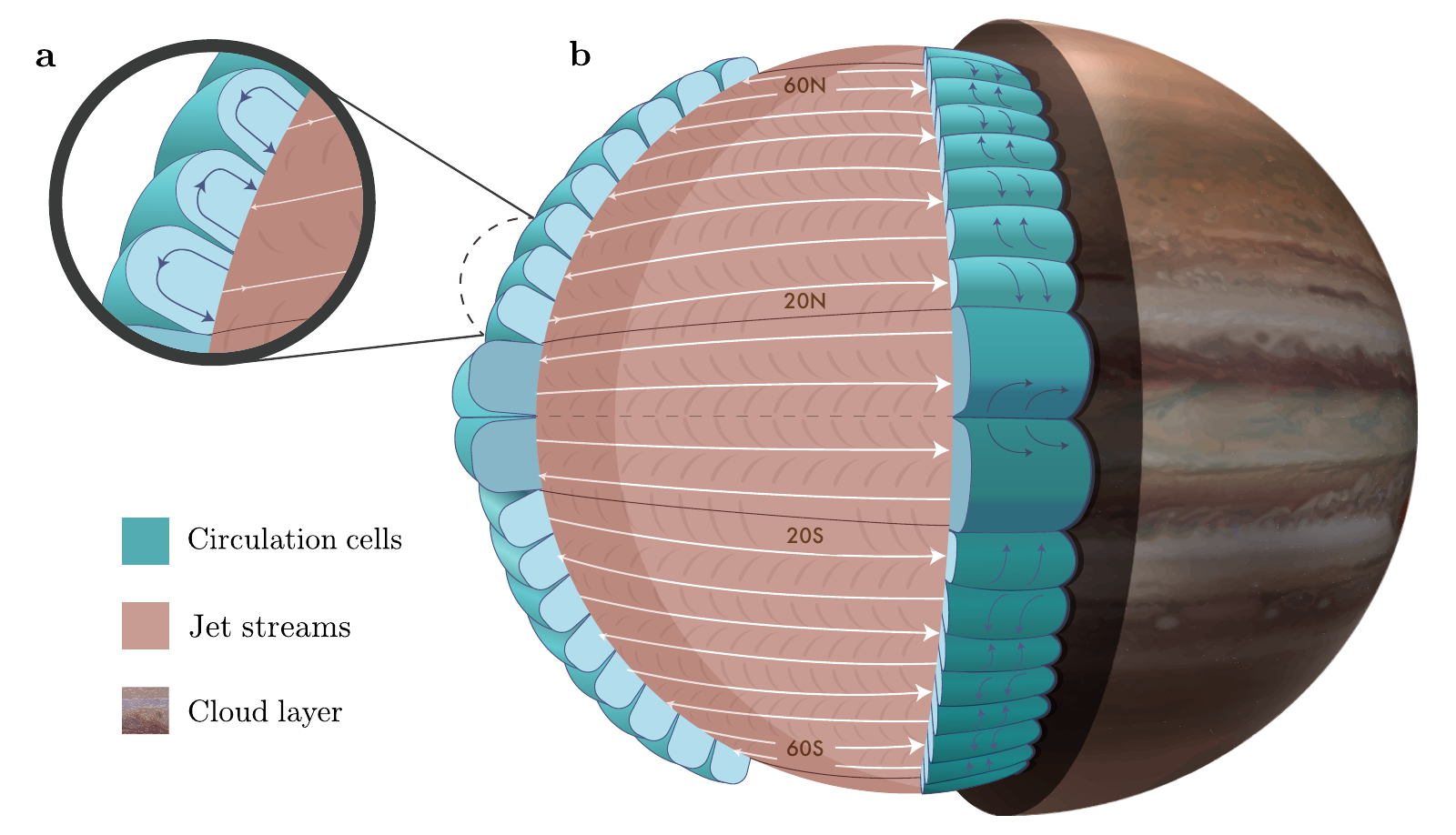
A schematic of the overturning circulation inferred from Juno observations. Alternating midlatitude cells accompany the jets.
Related publications
-
Manuscript in review
Planetary-Scale Convective Columns Detected on Jupiter
2026
-
From gas to ice giants: A unified mechanism for equatorial jets
2025 · Science Advances, 11 (41), eads8899
Published version ↗arXiv preprint ↗BibTeX
@article{duer2025jets, author = {Duer-Milner, Keren and Gavriel, Nimrod and Galanti, Eli and Tziperman, Eli and Kaspi, Yohai}, journal = {Science Advances}, doi = {10.1126/sciadv.ads8899}, number = {41}, year = {2025}, pages = {eads8899}, title = {From gas to ice giants: A unified mechanism for equatorial jets}, url = {https://arxiv.org/abs/2510.08020}, howpublished = {https://arxiv.org/abs/2510.08020}, volume = {11}, } -
Observational evidence for cylindrically oriented zonal flows on Jupiter
2023 · Nature Astronomy, 7 (12), 1463-1472
Published version ↗BibTeX
@article{kaspi2023flows, author = {Kaspi, Y. and Galanti, E. and Park, R. S. and Duer, K. and Gavriel, N. and Durante, D. and Iess, L. and Parisi, M. and Buccino, D. R. and Guillot, T. and Stevenson, D. J. and Bolton, S. J.}, journal = {Nature Astronomy}, doi = {10.1038/s41550-023-02077-8}, number = {12}, year = {2023}, pages = {1463--1472}, title = {Observational evidence for cylindrically oriented zonal flows on {Jupiter}}, volume = {7}, } -
Evidence for Multiple Ferrel‐Like Cells on Jupiter
2021 · Geophysical Research Letters, 48 (23), e2021GL095651
† Equal contribution
Published version ↗arXiv preprint ↗BibTeX
@article{duer2021cells,
	author = {Duer, Keren and Gavriel, Nimrod and Galanti, Eli and Kaspi, Yohai and Fletcher, Leigh N. and Guillot, Tristan and Bolton, Scott J. and Levin, Steven M. and Atreya, Sushil K. and Grassi, Davide and Ingersoll, Andrew P. and Li, Cheng and Li, Liming and Lunine, Jonathan I. and Orton, Glenn S. and Oyafuso, Fabiano A. and Waite, J. Hunter},
	journal = {Geophysical Research Letters},
	doi = {10.1029/2021GL095651},
	number = {23},
	year = {2021},
	note = {First two authors contributed equally},
	pages = {e2021GL095651},
	title = {Evidence for {Multiple} {FerrelLike} {Cells} on {Jupiter}},
	url = {https://arxiv.org/abs/2110.07255},
	howpublished = {https://arxiv.org/abs/2110.07255},
	volume = {48},
}